DE
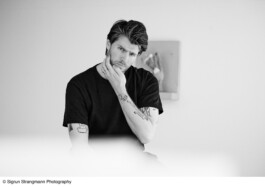
Die Arbeiten von Lennart Foppe (geboren 1991 in Lingen, lebt in Köln) bewegen sich im Spannungsfeld von Malerei und Installation. Ausgehend von einem Studium der Illustration und Fine Arts an der Münster School of Design entwickelt Foppe ein ästhetisches Vokabular, das sich aus raumgreifenden Installationen, alltäglichen Materialien und gefundenen Objekten zusammensetzt. Seine Arbeiten erzeugen den Eindruck autonom agierender Apparaturen und erinnern zugleich an organische oder biologische Strukturen, die scheinbar eigenen Gesetzmäßigkeiten folgen.
Die Installationen lassen sich als künstliche Biosphären lesen, in denen verschiedene Formen, Oberflächen und Prozesse miteinander in Beziehung treten. Einzelne Elemente wirken wie Zellen oder Mikroorganismen, die sich teilen, verbinden oder in andere Zustände übergehen. In diesen räumlichen Konstellationen entstehen Situationen, die an grundlegende biologische Prozesse erinnern und zugleich technische sowie künstliche Aspekte sichtbar machen.
An dieser Schnittstelle von organischer Anmutung und konstruiertem System setzt Foppes Arbeit an. Durch eine formal reduzierte Darstellung biologischer Vorgänge löst er diese aus ihrem naturwissenschaftlichen Kontext und überführt sie in eine räumliche, erfahrbare Situation. So entstehen Installationen, die biologische Formen und Dynamiken evozieren und gleichzeitig deren Wahrnehmung hinterfragen.
Die verwendeten Materialien – darunter Schaumstoff, Polyester oder Latex – verweisen auf Oberflächen und Strukturen, die an zelluläre Prozesse erinnern. Bei genauerer Betrachtung treten jedoch auch die technischen und künstlichen Aspekte der Konstruktion hervor: Fragile Mikrokosmen, deren Funktionsweise bewusst offen bleibt und sich dem unmittelbaren Verständnis der Betrachtenden entzieht.
EN
The works of Lennart Foppe (born 1991 in Lingen, lives in Cologne) move between painting and installation. The aesthetic vocabulary of Foppe, who studied Illustration and Fine Arts at the Münster School of Design, includes spatial installations made from everyday materials and objects. These create the impression of independently operating apparatuses and evoke biological forms that seem to function according to their own rules.
Foppe’s biologically evocative installations resemble biospheres in which each individual cell phase is subject to processual time intervals. Different bacterial stages attempt to divide or become active in other ways. Other organisms try to mate and become part of a larger cellular cycle. It is at this lively interface of organic activity that his work begins, thereby enabling an unobstructed view of actual human existence: a snapshot of biological surfaces and primordial forms, complemented by a multitude of technical references.
Through a formally reduced representation of biological processes in his works, Foppe removes them from their original scientific context and thus enables a critical mode of viewing them. As a consequence, the installations “alternative endeavors of the unknown” and “a gathering breaks” attempt to evoke biological forms by transferring temporally biological-scientific moments into spatial situations and thus making them perceptible. The objects, which consist of synthetic materials such as foam, polyester, or latex, refer to biological surfaces that occur in various intercellular processes. Upon closer observation, the human-technical aspects of their construction become visible: spontaneously placed microcosms whose exact function appears rather abstract and therefore remains opaque to the viewer.
»With a perceptive feeling towards materials, Lennart Foppe creates an interaction between the synthetic and the organic. His sculptures are an ensemble of contradicting shapes, textures and materials that engage with each other. He plays with their color, sometimes revealing the true characteristics of materials and sometimes hiding them, carefully choosing what he shows and doesn’t show. While some surfaces show shapes, others show prints, as if an object has just disappeared or a process has ended. Open structures show layers, suggesting an ongoing life underneath the surface.
The works visualize an invisible world of biological processes that are of tremendous importance for human life. They remind of drawings that we know from biology books; schematic representations made to explain biological processes that we cannot see with our eyes and would otherwise not understand. The drawings translate this intangible matter into a material language that we are more familiar with. They serve to understand what would otherwise be elusive but are simultaneously far from reality.
The material language Foppe uses, however, is ambiguous. The organic shapes, referring to biological processes and matter, are a great contrast to the synthetic materials, such as foam, silicone and plastics, in which they are carved, shaped and casted. They are known from industrial objects and are almost unrecognizable in another context. All having different properties that are very particular, they need to be properly understood to be of any use. Although the contrast between subject and matter creates tension, the required knowledge to process these materials equals the complexity of the biological elements they represent.
The combination of material and biological elements creates interesting narratives. Looking at the associative forms in Foppe’s work makes us wonder if we are facing a representation or interpretation of an invisible reality. But perhaps we are fooled by our desire to decipher and understand what we see, and the work does not explain to us anything at all.«
Daphne Kramer, 2022
Lennart Foppe operates in a threshold zone between painting and installation, between the organic and the artificial. His works do not lament, nor do they explain. Instead, they set material into motion, challenge perception, and open spaces in which the familiar grows quiet. Working with synthetic materials such as foam, polyester or latex, he draws a line between cellular processes and industrial products, between what appears grown and what is manufactured.
His installations often resemble microscopic apparatuses. They are structures that do not need to function in any utilitarian sense, yet they exist, breathe, persist. What matters here is not representation, but condensation. Time, surface and process are compressed into objects that suggest both biological systems we recognise and technical devices we can imagine. It is within this in between state that Foppe’s practice unfolds. A form of material knowledge emerges, neither naive nor self explanatory, but precise and quietly poetic.
For Foppe, a work is never simply a form. It is a condition. In his paintings, painting does not become a window but a surface, one that simultaneously protects and remains permeable. In his installations, space is not merely constructed but organised, steered and sensorially activated. What becomes visible is not only what is present, but the potential that lies dormant beneath the surface.
The beginning of a work is rarely singular. As Foppe describes it, it often starts with impulses drawn from everyday encounters. These may be spatial situations, particular forms or surfaces, or images and reports from biological contexts. From there, thought is modelled through sketches and provisional decisions. These sketches are not fixed plans, but working propositions that are repeatedly reconsidered, discarded and refined. The direction of a piece takes shape through this process of testing and adjustment, closely tied to an underlying idea that guides the object’s development.
Crucial early decisions are technical as much as conceptual. Questions of suspension or support, of whether an object hangs, stands freely or occupies the space differently, shape its trajectory. So do considerations of proportion and fragility. Filigree forms increase both difficulty and physical strain. Alongside these structural aspects, Foppe asks himself which biological surface perspective he wants to evoke and where the focus should lie. This focus, as he notes, does not necessarily need to be legible from the outside. “It has to be visible to me,” he says. It is this internal orientation that ultimately determines the direction of a work.
Materiality plays a decisive role throughout the process. Planning remains provisional, as materials often resist expectations. Many are altered to such an extent that they become almost unrecognisable by the end. This transformation is not a side effect but a central attraction. Materials that carry a reputation for flexibility and control may fail, while seemingly simple elements unexpectedly prove ideal. A common example, as Foppe recounts, is an everyday industrial component that reveals unforeseen potential, while a highly specialised material refuses cooperation. What matters is not mastery, but attentiveness. A material begins to give something back when it stops merely executing intention and starts redirecting it.
Over time, the artist’s own bodily perceptions have become increasingly relevant. The body makes the duality of strength and fragility unmistakably clear. This awareness translates into sculptural decisions, into the balance between weight and lightness, stability and vulnerability. An installation may be structurally solid in one area, while another part deliberately incorporates a fragile element. Functionality and authenticity are not opposites here. They coexist, held in tension.
There was no initial plan to share the work publicly. When this eventually happened, it was not driven by strategy but by circumstance. What continues to interest Foppe most are not affirming reactions, but moments of disturbance. The aim is not approval, but experience. To touch something in the viewer, or to set something in motion, matters more than unanimous agreement with an aesthetic position. The work seeks encounter rather than consensus. While exhibiting and presenting work is important, the primary motivation lies elsewhere. The practice functions as a means of articulating personal perceptions through objects and processes. It is, as he describes it, both an artistic and a personal exploration. Reaching others along the way is welcome, but not the governing objective.
Uncertainty is part of the process. A carefully developed plan that fails can be briefly unsettling. The counter movement to this doubt is persistence. Continuing despite disruption becomes an act of resolve. Both states belong to the work and neither is excluded. There are also aspects of
the practice that remain deliberately protected. One of them is the artist’s colour spectrum. It is restrained and avoids bright, intrusive tones. It does not adhere to realistic biological colour systems, either. This is a conscious decision. Form and material are meant to dominate, and excessive colour would interfere with that focus.
Knowing when a work is finished is rarely immediate. It unfolds over days, sometimes longer. Objects may already be packed away, only to be unpacked again for further observation and adjustment. Completion arrives as a sense of balance. A point at which form, colour, composition and spatial volume align and no longer demand intervention.
At present, Foppe is concerned with sharpening the specificity of form and activating space more intensely. He is interested in strengthening connections within installations and in expanding their components. Alongside hanging, standing and lying objects, he is exploring additional elements that further animate the spatial situation. He has also returned to watercolour painting, as he did at the beginning of his practice, working with muted tones and investigating the intersection between installation and painting. The question remains how form and space can be brought into an even more precise relationship.
What emerges from this practice is a quiet insistence. The works do not seek quick comprehension. They ask for time, for proximity, for a willingness to remain with surfaces and conditions that resist easy reading. Foppe’s art creates spaces of slowed perception, in which material becomes a site of reflection rather than representation. Not an answer, but an invitation to stay.
Sarah Maria Lillig, 2026